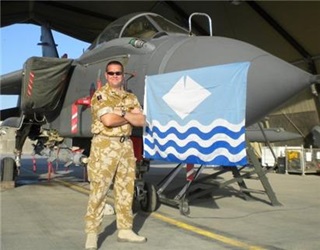
The flag of the Isle of Wight consists of a diamond shape (representing the island) hovering above the sea, with a large indentation in the diamond representing the river Medina: The island's largest river.
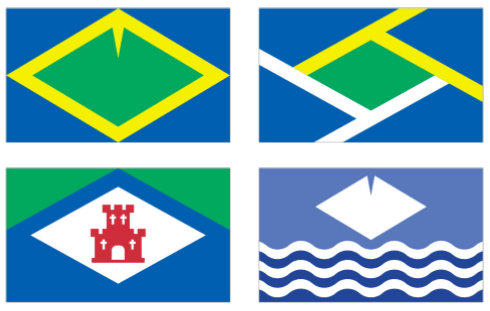
The flag was adopted officially in January 2009 after it won a public competition hosted jointly by the 'Isle of Wight Flag Committee' and The County Press (the most prominent island newspaper). The competition recieved over 350 entries, with the best four being shortlisted. The final four designs can be seen in the left-hand image below. After much deliberation, the committee settled on the diamond design by John Graney which was unfurled at county hall and is still in use today. Since 2009, it has gained much popularity and is now widely flown across the island: Privately, outside public buildings, beside war memorials and pubs. The top right image on this page shows the flag attached to an RAF Tornado flown by Flt Lt Gary Lewis.
Prior to the 2009 competition, the island had several flags in circulation: The first was the 'castle and anchors' design flown by the Isle of Wight council at the time, the second was the St. George's Cross (the national flag of England) which was used to represent the island at international sporting events such as the Island Games. The final pre-2009 flag was made up of green and white vertical stripes: This design endured somewhat in the public consciousness, alongside the castle and anchors design, and can still be seen occassionally today. Some who were unhappy with the diamond flag used it as their preferred banner post-competition, and thus it became known as 'the rebel green'.
The current flag is widely circulated, and has been a useful marketing tool for the island. You can find it on mugs, stickers, clothing and banners. Among private properties, it is easily as common as the St. George's Cross and can be seen across the Isle of Wight. Alongside it, you may occasionally spot the old castle and anchors design, the rebel green, the current flag but bearing a Union Flag ensign in the top left and also a more tourist-y flag featuring a St. George's Cross with the outline of the island within it.
Over the past 17 years, the flag has become ubiquitous to the island. It is now a great source of local pride, and provides a physical symbol for islanders to rally around.
There is no bridge or tunnel connecting the Isle of Wight to Hampshire on the mainland, with regular ferry services being the only way to access the island. There has long been movements to establish a fixed link to the mainland, however these continue to face stiff opposition from islanders, especially native Caulkheads.
Tourism is the primary engine for the Isle of Wight's economy, with over 2 million tourists visiting the island every year. This accounts for up to 38% of the island's GDP (currently worth 3.1 billion in GBP - similar to that of countries such as Greenland or Belize). Other prominent industries on the Isle of Wight include marine and military manufacturing, agriculture and fishing.